

DC Distribution Box for Solar — What It Is & Why You Need It
Somewhere between your solar panels and your inverter sits a small box most installers rush past. It’s called the DC distribution box, or DCDB. Without it, a single DC arc fault or a lightning-induced surge can travel straight into your inverter and destroy it.
The inverter is usually the most expensive single component in a solar system. Therefore, the DC distribution box exists to protect it, along with your panels, before real damage happens.
What Is a DC distribution box? (DCDB Full Form Explained)
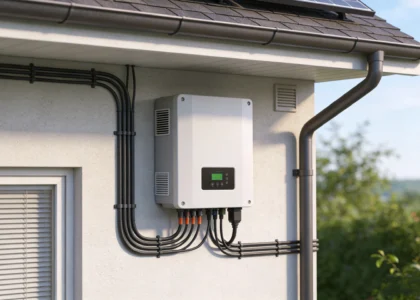
A DC distribution box is a protective electrical enclosure installed between your solar panels and your inverter. Specifically, it sits on the DC side of the system, before power conversion happens, unlike the ACDB on the AC side.
Every string of solar panels routes through the DCDB before reaching the inverter. In short, think of it as the checkpoint that catches DC-side faults before they reach the most expensive part of your system.
Where Does the DCDB Sit in Your Solar System?
Understanding where the DCDB sits makes the rest much clearer. In fact, here’s the complete flow of DC power in a typical rooftop system:
Step | Component | What Happens |
1 | Solar Panels | Generate DC electricity from sunlight |
2 | DCDB (DC Distribution Box) | Protects panels & inverter from DC-side faults |
3 | Solar Inverter | Converts DC to AC electricity for home use |
4 | AC Distribution Box (ACDB) | Protects inverter & home from AC-side faults |
5 | Main Distribution Board | Distributes power to all home appliances |
DC distribution box Components — What’s Inside the Box
This is what most people actually want to know. Below is a full breakdown of what sits inside a solar DC distribution box.
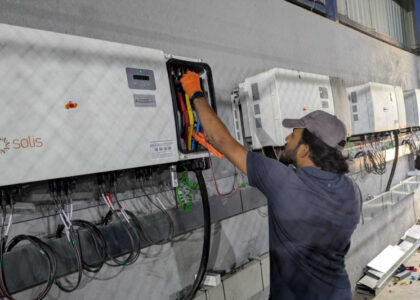
1. DC Isolator / Disconnect Switch
The DC isolator lets technicians safely disconnect the panel strings from the inverter. This matters especially during maintenance, since DC current can’t be switched off the way AC current can.
2. DC SPD — Surge Protection Device
Lightning strikes nearby, or sudden voltage spikes, can travel down the panel wiring into your inverter. As a result, the DC SPD diverts that surge safely to earth before it reaches sensitive electronics.
3. DC Fuses or DC-Rated MCB
Each string gets its own fuse or DC-rated breaker inside the DCDB. Consequently, if one string develops a fault, only that string trips, and the rest of the array keeps working.
4. IP-Rated Enclosure
Since the DCDB usually sits outdoors near the panel array, the enclosure needs an IP65 rating at minimum. In turn, this keeps out rain, dust, and insects.
5. Cable Glands and Entry Points
This matters because a single fault can cascade quickly through the array. In particular, moisture or dust reaching a DC connection point causes as much damage as an electrical surge.
Cable glands seal every point where wiring enters or exits the box. Otherwise, moisture works its way in over time and corrodes the connections inside.
DCDB vs Combiner Box — What’s the Difference?
People often assume these are the same thing, since both sit on the DC side. However, in practice, they solve slightly different problems.
A DCDB typically protects a single string or a small array with basic isolation, fusing, and surge protection. By contrast, a combiner box merges multiple panel strings into one output before that combined power reaches the inverter.
For larger installations with several strings, you’ll likely need both. Our combiner box page breaks down when a combiner box makes sense over a standard DCDB.
DCDB vs ACDB — Quick Recap
The DCDB and ACDB both protect your system, but on opposite sides of the inverter. Specifically, the DCDB handles faults before conversion, on the panel side.
The ACDB, meanwhile, handles faults after conversion, between your inverter and your home. For the full breakdown of what’s inside an ACDB and why it’s mandatory, see our detailed guide to AC distribution boxes.
How the DCDB Protects Your System
Specifically, here are the failure scenarios a proper DCDB prevents:
- DC arc fault — a loose or damaged connection sparks inside the wiring, which can start a fire if left undetected
- Lightning-induced surge — a nearby strike sends a voltage spike down the panel cabling toward the inverter
- String overcurrent — a fault in one string pushes excess current through the wiring, risking overheating
- Reverse polarity — incorrect wiring during installation sends current the wrong way through the system
- Water or dust ingress — a poorly sealed enclosure lets moisture reach live connections over time
Is a DCDB Mandatory for Solar Installations in India?
Yes, and it isn’t optional for a properly compliant system. Grid-connected rooftop solar in India falls under safety standards set by the Central Electricity Authority. These require documented protection on both the DC and AC sides.
Eligibility for subsidies under schemes listed on the Ministry of New and Renewable Energy website can also depend on using certified components. Skipping the DCDB, or using an uncertified box, risks both safety and subsidy eligibility.
Choosing the Right DCDB for Your System Size
System Size | Strings | Recommended Fuse Rating | SPD Type | Enclosure Rating |
1 – 3 kW | 1–2 strings | 10A – 16A DC fuse | Type 2 DC SPD | IP65 minimum |
3 – 6 kW | 2–4 strings | 16A – 20A DC fuse | Type 2 DC SPD | IP65 minimum |
6 – 10 kW | 4–6 strings | 20A – 25A DC fuse | Type 2 DC SPD | IP65 / IP66 |
10 – 20 kW | 6–10 strings | 25A DC fuse per string | Type 1+2 DC SPD | IP66 outdoor |
20 kW+ | 10+ strings | Custom per string | Type 1+2 DC SPD | IP67 floor-standing |
DC Distribution Box Price in India (2026)
Pricing varies with the number of strings, voltage rating, and SPD type. Generally, these ranges reflect the current market, though your final quote depends on your specific system:
Configuration | Approx. Price Range |
1 in / 1 out, basic MCB + SPD | ₹1,000 – ₹2,000 |
2 in / 2 out, DC SPD + fuse | ₹2,000 – ₹4,500 |
4 in / 4 out, DC SPD + fuse, 1000V | ₹4,500 – ₹8,000 |
6 in / 6 out, Type 2 SPD, 1000V | ₹6,000 – ₹9,500 |
10+ strings, Type 1+2 SPD, custom | ₹9,500 and above |
Why Eco Solar Energy Includes a Proper DCDB in Every Installation
We’ve seen what happens when installers skip the DCDB, or use an uncertified one to cut costs. For instance, inverters destroyed by a single monsoon surge. Meanwhile, fire risk from an undetected arc fault.
A few thousand rupees spent on a proper DCDB is far cheaper than replacing an inverter, or worse. Ultimately, it’s a small part of the system that carries an outsized share of the risk.
FAQ:
What is a DC distribution box in a solar system?
A DC distribution box (DCDB) is a protective enclosure installed between your solar panels and inverter. It isolates, fuses, and surge-protects the DC side of the system.
Is a DCDB the same as a combiner box?
Not quite. A DCDB protects a string or small array, while a combiner box merges multiple strings into a single output before the inverter.
Is a DC distribution box mandatory for solar installation in India?
Yes. Grid-connected systems must meet CEA safety standards, which require documented DC-side protection through a proper DCDB.
What’s the difference between a DCDB and an ACDB?
The DCDB sits before the inverter and protects the panel side. The ACDB, in turn, sits after the inverter and protects your home from AC-side faults.
Get in Touch with Eco Solar Energy
📞 +91-9845916006
🌐 ecosolarenergy.in
📍 #17, 2nd Cross, Mysore Road, Near Satellite Bus Stand, Bangalore-560026