

On-Grid vs Off-Grid Solar
When people decide to go solar, they quickly run into a question nobody warned them about. On-grid. Off-grid. Hybrid. Three different systems. Three very different outcomes for your home, your electricity bill, and your daily life.
What Is an On-Grid Solar System?
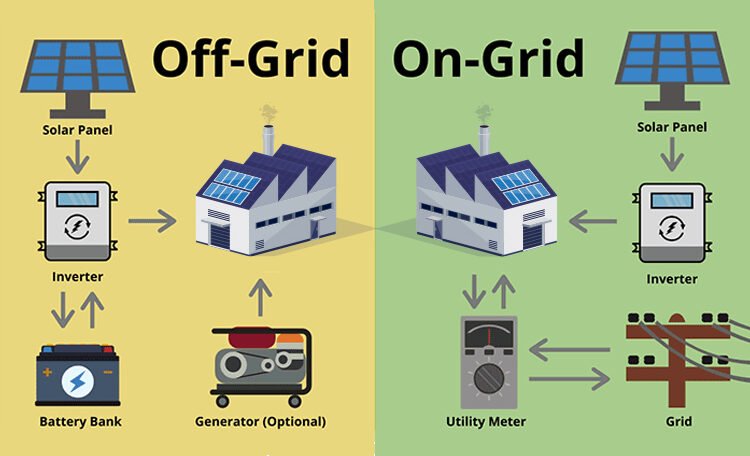
An on-grid solar system — also called a grid-tied system — is connected directly to the BESCOM electricity grid.
During the day, your solar panels generate power. Your home uses that power first. If your panels produce more than you need, the extra electricity flows into the BESCOM grid — and you earn credits for it. This is called net metering.
At night or on cloudy days, when your panels aren’t generating enough, your home draws power from the BESCOM grid as usual.
Key things to know about on-grid solar:
- No battery required — which keeps the cost low
- Eligible for PM Surya Ghar Yojana subsidy up to ₹78,000
- Earn money back through BESCOM net metering
- Switches off automatically during power cuts — this is a safety requirement
- Best for: Homes and businesses in areas with reliable BESCOM supply
What Is an Off-Grid Solar System?
An off-grid solar system works completely independently from the electricity grid. There is no BESCOM connection involved.
Your panels charge a battery bank during the day. That stored energy powers your home through the night and on cloudy days. You are entirely self-sufficient — no grid, no power cuts, no BESCOM bills.
Key things to know about off-grid solar:
- Requires a battery bank — adds to the overall cost
- Works 24/7 regardless of grid availability
- Ideal for locations where BESCOM connection is unavailable or unreliable
- Not eligible for net metering — excess power has nowhere to go
- Best for: Farmhouses, remote plots, rural areas, locations with 6+ hour power cuts
What Is a Hybrid Solar System?
A hybrid solar system combines the best of both worlds. It is connected to the BESCOM grid AND has a battery for backup.
During the day, solar power runs your home. Excess power charges your battery first, then flows to the BESCOM grid. At night, your battery kicks in. If the battery runs out, BESCOM takes over. During a power cut, your battery keeps your home running — unlike a standard on-grid system.
Key things to know about hybrid solar:
- Works during power cuts using battery backup
- Eligible for net metering — sell excess power to BESCOM
- Higher upfront cost due to battery
- Maximum flexibility and energy independence
- Best for: Urban Bangalore homes that want savings AND backup power
Can On-Grid Solar Work During a Power Cut?
This is not a flaw — it is a safety feature. If your solar panels kept feeding electricity into the grid during a power cut, it could seriously injure BESCOM technicians working on the lines to restore power.If backup power during cuts is important to you — you have two options. Either go hybrid with a battery, or install a separate inverter-battery alongside your on-grid system.
Which Solar System Is Best for Homes in Bangalore?
For most homes in Bangalore city — on-grid solar is the smartest choice.
Here’s why:
- Power cuts in most Bangalore urban areas are infrequent — sometimes just 1 to 2 hours a day or less
- On-grid systems are significantly cheaper since there’s no battery
- BESCOM net metering lets you earn credits for unused solar power
- Full subsidy eligibility under PM Surya Ghar Yojana
- Fastest payback period — typically 2 to 3 years
If your area experiences frequent and long power cuts — 4 to 8 hours daily — a hybrid system makes more sense. The extra cost of the battery is justified by the backup it provides.
Off-grid systems are rarely the right fit for Bangalore city homes. They make sense for farmhouses, remote land, or locations with no BESCOM connection at all.
Off-Grid Solar System — When Does It Actually Make Sense?
Off-grid solar is the right choice in a specific set of situations. If any of these apply to you — it deserves serious consideration.
- Your location has no BESCOM connection and getting one is expensive or impractical
- Your area faces power cuts of 8 to 12 hours every day
- You have a farm, resort, or remote property that needs power independently
- You want complete energy independence and are willing to pay more for it
For these situations, an off-grid system delivers something an on-grid system simply cannot — power that works no matter what the grid does.
Hybrid Solar — The Best of Both Worlds
If you want everything — solar savings, net metering credits, and backup power during cuts — hybrid is your answer.
A hybrid solar system costs more upfront because of the battery. But for many Bangalore homeowners, the peace of mind is worth it. Your lights stay on during cuts. Your inverter runs on solar during the day. And at the end of the month, your BESCOM bill is near zero.
The sweet spot for hybrid systems in Bangalore: homes with a monthly bill above ₹3,000 and areas that experience at least 2 to 4 hours of power cuts regularly.
FAQ:
Q: What is the main difference between on-grid and off-grid solar?
On-grid solar is connected to the BESCOM electricity grid — it uses the grid as backup and earns net metering credits.
Q: Which is cheaper — on-grid or off-grid solar?
On-grid is significantly cheaper because it does not require a battery bank. For the same system size, an off-grid system can cost 40 to 60% more due to battery costs.
Q: Can I add a battery to my on-grid solar system later?
Yes — this is exactly what a hybrid system does. If you start with an on-grid system today and want to add battery backup later, we can upgrade it to a hybrid setup.
Q: Is on-grid solar eligible for government subsidy in India?
Yes. On-grid and hybrid solar systems are eligible for the PM Surya Ghar Yojana subsidy of up to ₹78,000. Pure off-grid systems have limited subsidy eligibility.
Q: Which solar system is best for a Bangalore home with occasional power cuts?
For areas with power cuts of 1 to 2 hours daily — on-grid with a small UPS or inverter backup is usually sufficient.
Not Sure Which System to Pick? We’ll Help You Decide
The right solar system depends on your location, your electricity consumption, your budget, and how often power cuts affect your area. There is no one-size-fits-all answer.
What we do at Eco Solar Energy is simple. We visit your site, look at your electricity bills, understand your priorities, and recommend the system that actually makes sense for your home — not the most expensive one, not the cheapest one. The right one.
📞 Call / WhatsApp: +91-9845916006
🌐 Visit: ecosolarenergy.in
📍 #17, 2nd Cross, Mysore Road, Near Satellite Bus Stand, Bangalore-560026