

On-Grid vs Off-Grid vs Hybrid Solar: Which Fits Your Bangalore Home?
Going solar sounds simple until someone asks you to pick a system. On-grid. Off-grid. Hybrid. Three names, three very different experiences — for your electricity bill, your backup during a power cut, and how much you pay upfront.
Here’s the plain version, without the sales pitch.
What Is an On-Grid Solar System?
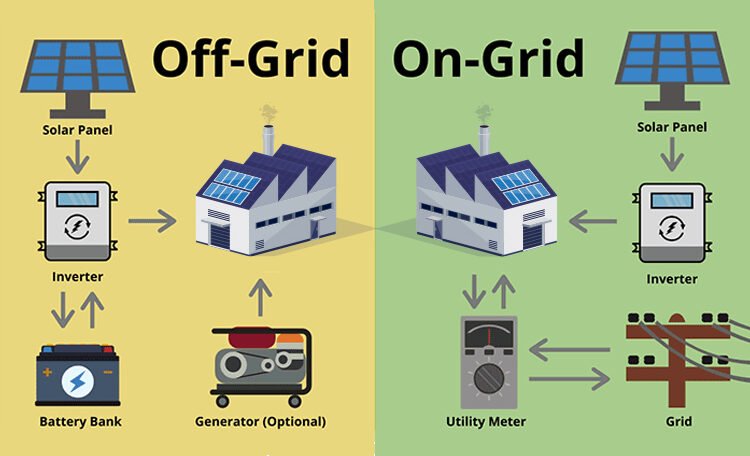
An on-grid system — also called grid-tied — stays connected to the BESCOM grid at all times.
By day, your panels power the home first. Anything extra flows into the BESCOM grid, and you earn credits for it through net metering. By night or on a cloudy day, the grid simply fills in the gap, the way it always has.
A few things worth knowing:
- No battery, which is why it’s the cheapest system to install
- Eligible for the PM Surya Ghar Yojana subsidy of up to ₹78,000
- Earns real credits through BESCOM net metering
- Shuts off automatically during a power cut — not a fault, a safety rule
Best for: homes and businesses in areas where BESCOM supply is mostly reliable.
What Is an Off-Grid Solar System?
An off-grid system skips BESCOM entirely. There’s no grid connection at all.
Your panels charge a battery bank through the day, and that stored energy carries the home through the night and through cloudy stretches. No grid, no BESCOM bill, no outage to wait out — but also no net metering, since there’s no grid to send surplus power to.
- Needs a battery bank, which raises the cost noticeably
- Runs independently of grid availability, 24/7
- Right for places where a BESCOM connection is unavailable or unreliable
- Excess power has nowhere to go, since there’s no grid
Best for: farmhouses, remote plots, and areas with 6+ hours of daily power cuts.
Where Hybrid Fits In
A hybrid system is the middle ground — grid-connected like an on-grid system, but with a battery that kicks in the moment BESCOM cuts out. If that backup-during-outages piece matters to you, it’s worth a closer look at how hybrid actually compares to on-grid — we’ve laid out the cost difference and the power-cut behaviour in detail there.
Can On-Grid Solar Work During a Power Cut?
No, and that’s deliberate. If your panels kept pushing electricity into the grid during an outage, it could seriously injure a BESCOM technician working to restore the line. It’s a safety feature, not a design flaw.
If backup power matters to you, you’ve got two routes: go hybrid with a battery, or run a separate inverter-battery setup alongside your existing on-grid system.
So Which One Actually Fits a Bangalore Home?
For most homes in Bangalore city, on-grid comes out ahead — and the reasons are fairly concrete:
- Most urban areas see power cuts of just 1-2 hours a day, often less
- No battery means a meaningfully lower upfront cost
- Net metering credits reduce the bill further
- Full subsidy eligibility under PM Surya Ghar Yojana
- Payback typically lands in 2-3 years
If your area sees longer, more frequent cuts — say 4-8 hours a day — a hybrid system starts to justify its extra cost. And off-grid rarely makes sense inside the city; it’s built for places with no BESCOM connection at all, not for suburban Bangalore.
When Off-Grid Actually Does Make Sense
A few situations where it’s genuinely the right call:
- No BESCOM connection nearby, and getting one is impractical or expensive
- Power cuts running 8-12 hours a day
- A farm, resort, or remote property that needs to run independently
- You want complete energy independence and are fine paying more for it
In any of these, an off-grid system does something on-grid simply can’t — it keeps running regardless of what the grid is doing. Pairing it with the right battery storage setup is the part most people underestimate, and it’s worth getting sized correctly from the start.
The Subsidy Side of the Decision
Cost is rarely the whole picture once PM Surya Ghar Yojana enters the conversation. We’ve broken down exactly how the subsidy and loan options work for Bangalore homes — worth a look before you commit to a system size, since the subsidy slab can shift which option is actually cheaper.
FAQ
What is the main difference between on-grid and off-grid solar?
On-grid solar stays connected to the BESCOM grid, using it as backup and earning net metering credits. Off-grid solar runs entirely on its own battery bank, with no grid connection at all.
Which is cheaper — on-grid or off-grid solar?
On-grid is significantly cheaper, since it doesn’t need a battery bank. For the same system size, off-grid can cost 40-60% more because of battery costs.
Can I add a battery to my on-grid system later?
Yes — that’s effectively what upgrading to hybrid means. If you start on-grid today, we can add battery backup later and convert it to a hybrid setup.
Is on-grid solar eligible for a government subsidy in India?
Yes. On-grid and hybrid systems qualify for the PM Surya Ghar Yojana subsidy of up to ₹78,000. Pure off-grid systems have limited subsidy eligibility.
Which system is best for a Bangalore home with occasional power cuts?
For areas with 1-2 hours of daily cuts, on-grid paired with a small UPS or inverter backup is usually enough.
Not Sure Which System to Pick? We’ll Help You Decide
The right solar system depends on your location, your electricity consumption, your budget, and how often power cuts hit your area — there’s no one-size-fits-all answer. At Eco Solar Energy, we visit your site, review your electricity bills, and recommend the system that actually fits your home, not the most expensive one on the shelf.
📞 +91-9845916006
🌐 ecosolarenergy.in
📍 #17, 2nd Cross, Mysore Road, Near Satellite Bus Stand, Bangalore-560026